ERWIQ — The Intelligent Engineer
From mission requirements to a complete aerospace design.
Turn mission requirements into engineering designs with deterministic aerospace methods, orchestrated by AI. Every calculation is explainable, reproducible, and traceable to the tool run that produced it.
Regional electric aircraft, Fixed-wing UAVs and drones.
Powered by deterministic engineering methods, not generative design guesses.
- Requirements
- Sizing
- Propulsion
- AnalysisComing soon
- Geometry & CADComing soon
- Documentation
What you can design
Aerospace products, not just aircraft.
- Regional electric aircraft
- Conventional & Hybrid AircraftComing soon
- eVTOLComing soon
- Fixed-wing UAVComing soon
- DroneComing soon
The problem
Conceptual design lives in a dozen disconnected tools.
Requirements in spreadsheets, sizing scripts in MATLAB and Python, aero runs in XFOIL and AVL, and the results stitched into documents and slide decks by hand. Every handoff is manual — data re-entered, assumptions lost along the way.
- Excel
- MATLAB
- Python
- XFOIL
- AVL
- Reports
- PowerPoint
- Mission
- Engineering Engine
- Aerospace Design
- Documentation
The same established methods, run as one orchestrated flow — with every result traceable to the tool run that produced it.
Platform
Built for engineers who have to defend the numbers.
Three things hold the platform together — and every design run rests on all three at once.
Engineering Intelligence
Describe the mission in plain language — range, payload, endurance, launch constraints. ERWIQ turns it into a structured design spec and plans the work.
Deterministic Engineering
The numbers come from real engineering code, not a language model. The same requirement run twice gives the same design, because the methods are deterministic.
Explainable Results
Every value carries its source — your input, a matched reference aircraft, or a cited lookup — and refinements mark what was recomputed and what carried forward.
How it works
Requirements in, engineering out.
One design run, every step explicit — the numbers you see are the numbers the tools produced. Two stages are still placeholder models, and are marked.
Requirements
Your mission, parsed into a structured design spec.
Sizing
Constraint diagram and a converged mass and wing-area solution.
Propulsion
Battery and motor mass, mission energy and peak power.
Analysis
Coming soonAirfoil selection, aerodynamics and stability.
Geometry & CAD
Coming soonOuter mold line and exportable CAD.
Documentation
A structured engineering report, generated from the run.
The product
Numbers with provenance.
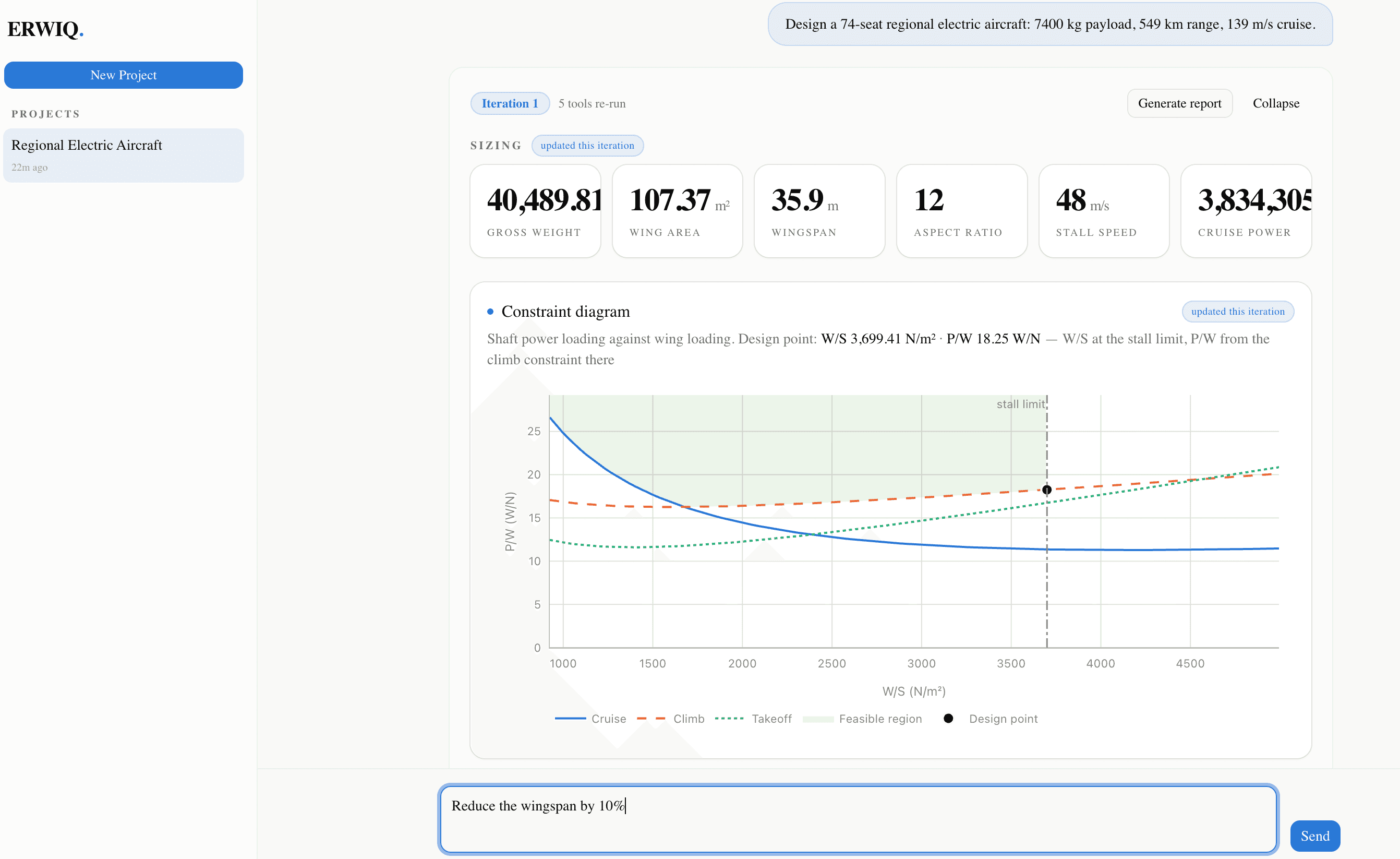
A real design run in ERWIQ — conceptual sizing and the constraint diagram behind its design point, with the next refinement being typed in.
Philosophy
Engineering First.
AI Second.
Deterministic engineering
The physics runs as real engineering code. Same requirement, same design — no sampling, no drift.
AI orchestrates, never invents
The model reads your requirement, plans the work and calls the tools. It does not supply the numbers.
Every value carries its source
Your input, a matched reference aircraft, or a cited lookup — labelled per field, including when a source is unverified.
Engineers stay in control
Refine a design and each section is marked as recomputed or carried forward, so you can see exactly what moved.
Built for aerospace engineers designing new products, who want the automation without giving up scrutiny.
Vision
The future of aircraft design is collaborative.
- Engineers define the intent.
- ERWIQ runs the workflow and keeps the trace.
- The engineer makes the decisions.
Start with a mission.
Describe the requirement in plain language — ERWIQ runs the sequence and shows its work.
Start Designing